 Minnesota Then
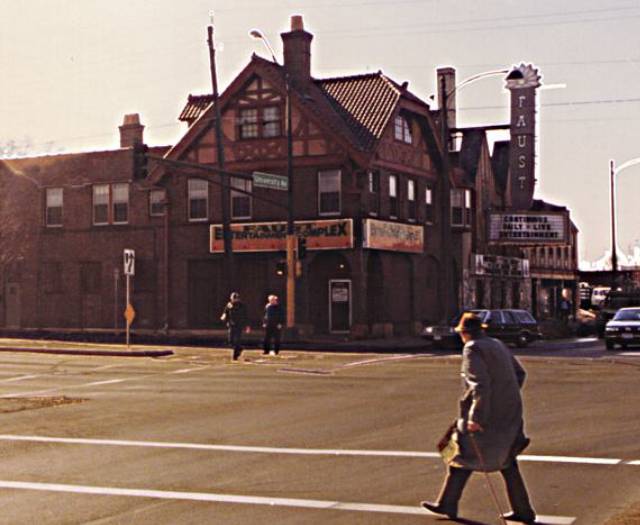
In the city's Thomas-Dale neighborhood (historically known as Frogtown), the Faust Theatre, formerly located at 626 W. University Ave., was opened in 1911–12 by H.J. “Heinie” Breilein. For a large part of its history, including a couple of ownership changes, the theater ran as a quiet, family-friendly business.
For decades the Faust was a social hub, a place where generations marked first dates, Saturday matinees and wartime newsreels. By the late 1950s the movie-going public had begun to migrate to the suburbs, taking its entertainment dollars with it. With revenues shrinking, the 834-seat house closed its doors and was put on the market in the early 1960s. The building was then leased to an evangelical church for a brief period.
During the early 1970s, the property was acquired and reopened on March 26, 1971, reinvented as an x-rated theater. In addition to its expansive main auditorium, the Faust provided patrons with ‘peep shows’ and a pornographic bookstore. Shortly thereafter, a corresponding scene emerged on the northeast corner of the same intersection: the Belmont Club, a notorious strip lounge at 615 University, and The Flick, an adjacent 85-seat x-rated theater. Together, these businesses turned the intersection into a magnet for adult entertainment.
The neighborhood became a hotbed for x-rated movies, drug trafficking, prostitution, and other illegal activities. Despite legal challenges referencing the city's obscenity ordinance, all three establishments remained open. After the police department took him on a “ride-along” in the 1980s, then-mayor George Latimer decided to shut down this “supermarket of porn in the Twin Cities.”
He saw first-hand the problems in the area, including the influx of prostitutes and drug dealers attracted to the surrounding community. Although he believed the businesses had the right to exist and that no one was forced to enter, he realized the Faust, Flick, and Belmont had a devastating collective effect on the neighborhood.
During the late 1980s, city leaders reached an agreement-in-principle for the Flick to close as soon as the Faust was out of business. When the agreement never came to fruition, the city began its battle to shut down the entire “vice triangle.” The Faust owners briefly considered relocating their business further down University Ave., but legal issues—including a six-month moratorium on x-rated businesses while the city's pornography ordinance was being crafted—made that move impossible.
In an attempt to avoid a lengthy legal battle, the city tried to exercise a 1983 agreement that let it buy the Flick for roughly $300,000 once the Faust closed. When negotiations stalled in 1987, St. Paul moved ahead with eminent domain and a broader buyout strategy. By March 1989, the city had formally shuttered the Faust, Flick, and Belmont Club, paying a combined $1.83 million to clear the corner. Neighbors hailed the payout as a small price for a remarkable victory.
On March 6, 1989, the tumultuous relationship between the city and the three establishments finally came to an end—but not without some fireworks. At an 11:30 AM press conference held in front of the Faust, a crowd gathered to pronounce victory and began plastering the building with signs announcing its “death.” Councilperson Kiki Sonnen later described the atmosphere as an impromptu party, but the celebration was cut short when someone inside the theater threw a bucket of dirty water from an upper-level window onto the crowd below.
Among the soaked activists was a KSTP television photographer and his now ruined $40,000 camera. The manager was confronted by angry protesters who entered the building. There was a fight. The police were called and everyone was sent on their way. By the morning of March 7, the Faust Theatre was out of business.
While the Faust was gone, the legal dust had yet to settle on the northeast corner. City leaders changed ordinances to keep future pornography merchants from offering multiple types of ‘entertainment’ under one roof. The days of the Faust, the Belmont, and places like them were officially over in Saint Paul. After the ordinance update, the Flick—realizing it was the only theater left in town that could provide multiple types of pornographic material—sued to continue doing business. It was in vain. Later the same year, The Flick and the Belmont Club finally closed their doors for good.
To have the adult businesses close their doors and completely leave Saint Paul, the city paid far more than the properties' actual value. Following the closures, the fate of the physical structures became the next point of debate. After weighing the buildings' historical value against the steep costs of repair, neighborhood activists and city leaders decided the structures should be leveled, giving the area an opportunity to start anew.
While the city council successfully removed the vice triangle from St. Paul, the victory was localized. The Faust owners, armed with a large ‘get out of town’ payment, crossed the river to Minneapolis to continue their trade. Following the death of James Hafiz in early 1990, his family—led by his son Peter—used the proceeds from the St. Paul sale to open Deja Vu in the Warehouse District that July, marking the start of a decades-long nightlife empire.
The Faust Theatre was razed in the summer of 1995. On August 1, 1995, city leaders, community members, and other onlookers buried a symbolic coffin on the site. The Rondo Community Outreach Library opened on the corner on September 9, 2006.