 Minnesota Then
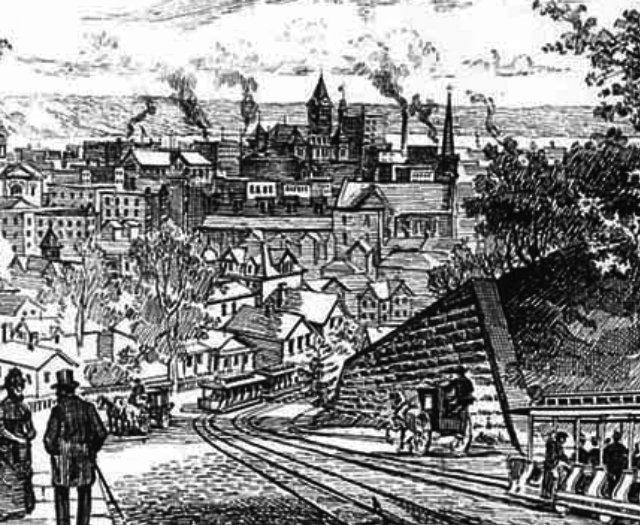
By the late nineteenth century, Saint Paul had a structural problem. The treacherous grade of St. Anthony Hill (now known as Cathedral Hill) acted as a vertical wall, constraining efficient westward expansion from the growing downtown and exposing the limitations of local transit. Initial attempts to operate streetcars on the steep hill proved challenging and, in some cases, unsafe. The eventual solution was to bore a tunnel through the hill and lessen the incline. Completed in the early twentieth century, the tunnel allowed streetcars to reach neighborhoods west of downtown more reliably and made the cross-town commute a practical reality.
On January 21, 1888, after a crew of roughly 300 men spent the day clearing ice and snow from the tracks, the St. Paul City Railway Company ran its first car over the new Selby Avenue cable line. Powered by a steam-driven powerhouse located near the intersection of Selby Avenue and Dale Street, a 1.5-inch steel cable buried beneath the street pulled streetcars up a 16 percent slope that had often defeated horse-drawn cars. Thomas Lowry, who would later merge the St. Paul and Minneapolis systems into the Twin City Rapid Transit Company (TCRT), oversaw the development of the Selby Avenue line. The system's debut, however, was marred by a catastrophic failure within its first week of service.
The terrible accident occurred within days of the Selby Avenue cable line's opening. Just before 2 p.m. on January 27, a grip car and its trailing passenger car were descending the hill when the mechanism lost its hold on the cable. The hand brake failed to stop the runaway cars. Filled with passengers, they plummeted roughly 500 feet down the incline. While the grip car successfully navigated the curve at the bottom, the passenger car did not, jumping the tracks and toppling as it reached West Third Street. The wreck resulted in nearly two dozen injuries of varying severity and one death.
Over the next decade, while the rest of the city's transit modernized, the Selby Avenue cable line's ongoing volatility and safety challenges prompted a major engineering shift. In 1898, the last cable-operated holdout was converted to electric power, a change that required a complete track overhaul and the installation of a system to help streetcars navigate the hill's steep grade.
Climbing and descending the hill was now safer, but still far from efficient. Cars were restricted to speeds under 10 mph in this section, as each trip required careful coordination with the counterweight mechanism. To effectively balance the load, only one car could be manually tethered at a time, creating frequent slowdowns. In winter, snow and ice often jammed the counterweight slot, worsening the delays. To address these persistent bottlenecks, TCRT resolved to construct a tunnel that would reduce the grade and eliminate the need for mechanical assistance to navigate the hill.
Construction of a 1,472-foot tunnel began in 1906, stretching from Nina Street to Third Street. It was built using a cut-and-cover method: a section of Selby Avenue was excavated, a tunnel wide enough for two tracks was constructed, and the street was then covered over. Opened to the public on August 10, 1907, the project cost $366,000. It lowered the hill's grade from 16 percent to a manageable 7 percent, allowing electric cars to navigate the section without a counterweight system and rendering it obsolete.
The tunnel's reduced grade brought immediate improvements to service speed and reliability. Where the counterweight system had once slowed cars and limited operations, electric streetcars could now maintain consistent speeds along the entire route. Schedules became more predictable, and the chronic delays that had long plagued the Selby Avenue crossing were largely eliminated. The faster, more dependable service helped establish the Selby–Lake line as one of the Twin Cities' busiest streetcar corridors. Streetcar suburbs such as Crocus Hill and Merriam Park expanded along the line, as reliable commutes made it practical for middle-class families to live farther from downtown. Commercial development followed.
Initially, the line ran from St. Albans Street to Broadway via Selby Avenue, Third Street, and Fourth Street. Its western terminal was later extended to Chatsworth before finally connecting with the Lake Street line at the Marshall–Lake Street Bridge in 1906, forming the Selby–Lake line. This created one of the busiest cross-city streetcar routes in the Twin Cities. By 1910, the efficiency of the tunnel and the expansion of the TCRT network made it possible for a passenger to travel from Excelsior, through the heart of the city to the western bank of the St. Croix River in Stillwater, entirely by streetcar.
After World War II, streetcar ridership began to decline. In 1953, the Selby-Lake line was abandoned as part of an effort to convert all rail lines to bus transit and an increasing number of automobiles. The last streetcar traveled the Twin Cities the following year. In 1959, the tunnel, deemed too narrow for two-way vehicular traffic and too steep for one-way connectivity to neighboring streets, was sealed.