 Minnesota Then
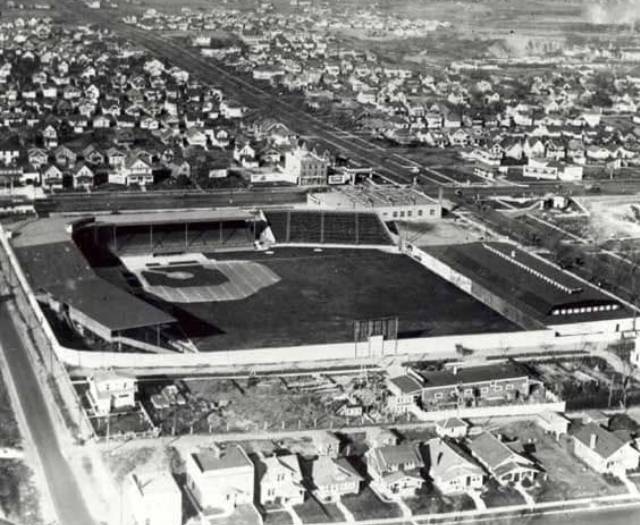
Lexington Park stood at the intersection of Lexington Parkway, University Avenue, Fuller Avenue, and Dunlap Street from 1897 to 1956. For nearly six decades, it anchored the Western League’s St. Paul Saints, housing the team through multiple ownership changes and league affiliations. Buffalo real estate investor Edward B. Smith built the park for $75,000 at the request of team owner Charles Comiskey; it opened on April 30, 1897, along the streetcar line to immediate fanfare.
After two seasons at Aurora Park, the Saints moved to Lexington Park in 1897. Comiskey did not own the grounds, but the site offered a distinct advantage: the neighborhood did not restrict Sunday play, effectively ending a scheduling dispute that had dogged the team for years. Home plate sat in the southwest corner, creating an asymmetrical outfield unlike the cramped, square-shaped city lots of earlier ballparks. For a franchise that had spent two seasons scrambling to find a venue for Sunday games, the new ballpark was a declaration of permanency. The Saints had found their home.
The arrangement was always Smith's venture; he needed a reliable renter, and the Saints needed a legal venue for Sunday gates. This held for three seasons until Comiskey moved the franchise to Chicago after 1899, where it became the White Stockings (later the White Sox). A new Saints franchise, owned by St. Paul clothing merchant George E. Lennon and playing in the new Western League, arrived in 1901 and made Lexington Park its first home.
Fan enthusiasm rebounded after the lost 1900 season, and the Saints became a charter member of the American Association in 1902. By 1903, however, the same distance that had made Lexington Park useful for Sunday games worked against it on weekdays—the streetcar ride was too long for post-work attendance. The league pressured Lennon to secure a more accessible location, prompting him to build the Downtown Park (Pillbox). For six seasons, the team split their schedule: weekday games moved downtown, while Lexington Park remained the mandated home for Sunday baseball.
The park remained a destination beyond baseball; on July 18, 1908, thousands gathered to witness the launch of the World’s Championship balloon races. The excitement was short-lived, however, as a fire destroyed the wooden grandstand that October, causing an estimated $7,000 in damages. Recovery came the following summer when, in June 1909, Lennon signed a ten-year lease to return the Saints to the park full-time. In 1910, he committed to the property’s future, purchasing it outright from Smith for $75,000.
In 1915, a second fire destroyed the grandstand, causing $20,000 in property damage. Lennon rebuilt with steel and concrete, rotating the diamond ninety degrees. Home plate moved from the southwest corner to the northwest corner. The Lexington Park that emerged was architecturally a new facility on the same footprint, with a modern grandstand and a reoriented field that remained unchanged for the rest of its existence.
The rebuilt park developed a distinct character. The Pavilion Coliseum became part of the left-field fence, and patrons could often hear the sound of baseballs striking its roof. In right field, a large "Keys Well Drilling" sign dominated the view, and a distant 365-foot fence meant few home runs to that side. In the 1930s the park was modernized; lights were installed in 1937, and the first night game was played on July 15, 1937, against the Minneapolis Millers.
By the 1950s, the park was showing its age. Nearby Midway Stadium, with a larger capacity and more modern design, offered an experience that Lexington Park could not match. With the neighborhood changing and the streetcar era ending, the park was scheduled for demolition.
The final game played at Lexington Park occurred on September 5, 1956, when Stan Williams shut out the Minneapolis Millers and Roy Hartsfield's eighth-inning home run sealed a 4–0 Saints win in front of a sparse crowd of just over 2,000. Neither team realized it was the finale, as the Saints still held playoff aspirations and finished the season on the road in Omaha. The park was demolished shortly thereafter, and by 1958 a Red Owl grocery store stood on the site, with a plaque embedded in its floor marking the approximate location of home plate.