 Minnesota Then
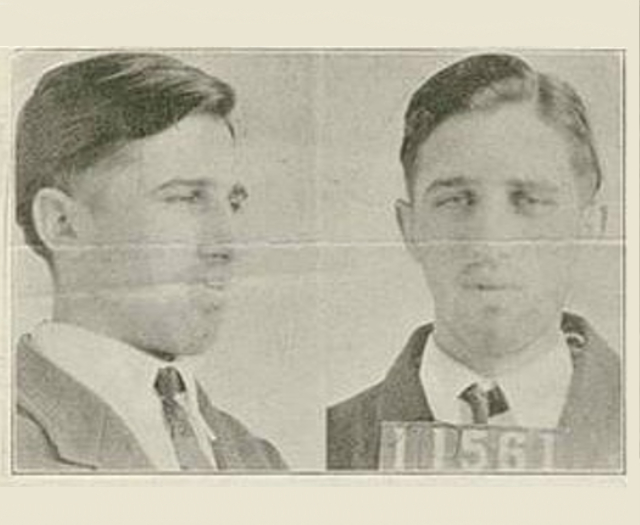
On August 23, 1934, a deadly gunfight between police and Depression-era gangster Homer Van Meter—a former lieutenant in John Dillinger's gang—erupted near the intersection of University Avenue and Marion Street in St. Paul. The final moments of his life played out just south of University, ending in a dead-end alley just off Marion Street.
Around 4:45 p.m., Van Meter entered St. Paul Auto Company on University Avenue. He intended to buy a 1933 Chevrolet and flee the area before authorities could catch him. At 5:10 p.m., he emerged carrying a straw hat and a package, walking west on University toward Marion Street. He encountered three armed officers conducting surveillance in an unmarked car: Detective Thomas J. Brown, Detective Leo Gorman, and Patrolman John J. Ryan. The officers had positioned themselves near the intersection after receiving a tip from a confidential informant that Van Meter would be at the dealership.
The officers waited until Van Meter passed their vehicle. As he did, Brown and Gorman emerged, ordering him to stop. Van Meter immediately drew his .38-caliber Colt pistol, spun, and fired twice at Detective Brown, missing both times. He sprinted across University Avenue, heading south on Marion Street, chased by a hail of gunfire from the officers. He ran approximately 300 feet before turning into a 30-foot blind alley.
Discrepancies in eyewitness accounts soon fueled debate over what happened next. While Van Meter's death is undisputed, the moments immediately preceding it have long been called into question.
According to official FBI reports, the officers chased the fugitive into the alley, firing as they closed in. Van Meter turned and fired a third shot (the spent shell was later found in his gun). He dropped to the ground. By the time they reached him, he was dead, his pistol still in hand, hammer cocked.
Eyewitness Mrs. Andrew Stedje, standing on the southeast corner of University and Marion, told a different story. She saw Van Meter—hat in hand—running south toward the alley with officers in pursuit. Concerned for her nearby children, she followed. Stedje claimed the officers opened fire upon reaching the alley entrance. She stated that after Van Meter crumpled to the ground, the officers approached and fired several additional shots into his prone body.
The autopsy report by Dr. O.H. Sletness confirmed Van Meter suffered 17 gunshot wounds, with three bullets striking his heart and lungs. Newspapers of the day, including the Minneapolis Star and Indianapolis Times, reported anywhere from 17 to 27 wounds, far fewer than the "dozens" some later accounts claimed.
Officers reportedly picked up Van Meter's straw hat from the ground and placed it over his mortally wounded face. They recovered $1,323 in cash, $2,000 in jewels, and a $500 Liberty bond from his body. Those familiar with Van Meter scoffed at the official amount, believing he had carried far more—estimates ranged from $9,000 to $18,000. However, FBI files contain no evidence of missing money, and the recovered amount was consistent with what a fugitive might carry for immediate travel expenses.
In the days after the shooting, multiple witnesses stated Van Meter never pointed a gun at officers. They reported that he held his hat in one hand and that his other hand may have been empty. However, physical evidence contradicted these claims. The official investigation confirmed Van Meter's pistol was found in his hand with three spent shells, indicating he had fired at police.
Van Meter may have been set up—but by whom remains unclear. Official reports suggested a dealership employee or acquaintance tipped off police. Others believed his own gang betrayed him. Baby Face Nelson had reportedly vowed to kill Van Meter after the gangster hoarded robbery proceeds and acted increasingly erratic in the weeks before his death.
Detective Thomas Brown, who fired the fatal shots, faced his own troubles. He was forced to resign from the St. Paul Police Department in 1935 after a Department of Justice investigation into widespread police corruption. Though suspected of ties to the Barker-Karpis gang, Brown was never officially linked to the Hamm or Bremer kidnappings and was never arrested. He died in 1947, his law enforcement career long over.
When Van Meter's body was returned to his family, they were appalled by the condition in which they received it, believing police had used excessive force. After a private funeral, he was buried at Lindenwood Cemetery in Fort Wayne, Indiana.
Homer Van Meter's death sent a message that the tide was turning against gangsters. Yet contradictions between eyewitness testimony and official accounts have never been fully resolved. Whether he was killed in self-defense or executed in that alley remains an open question that continues to fuel debate among historians of the Depression-era criminal underworld.